
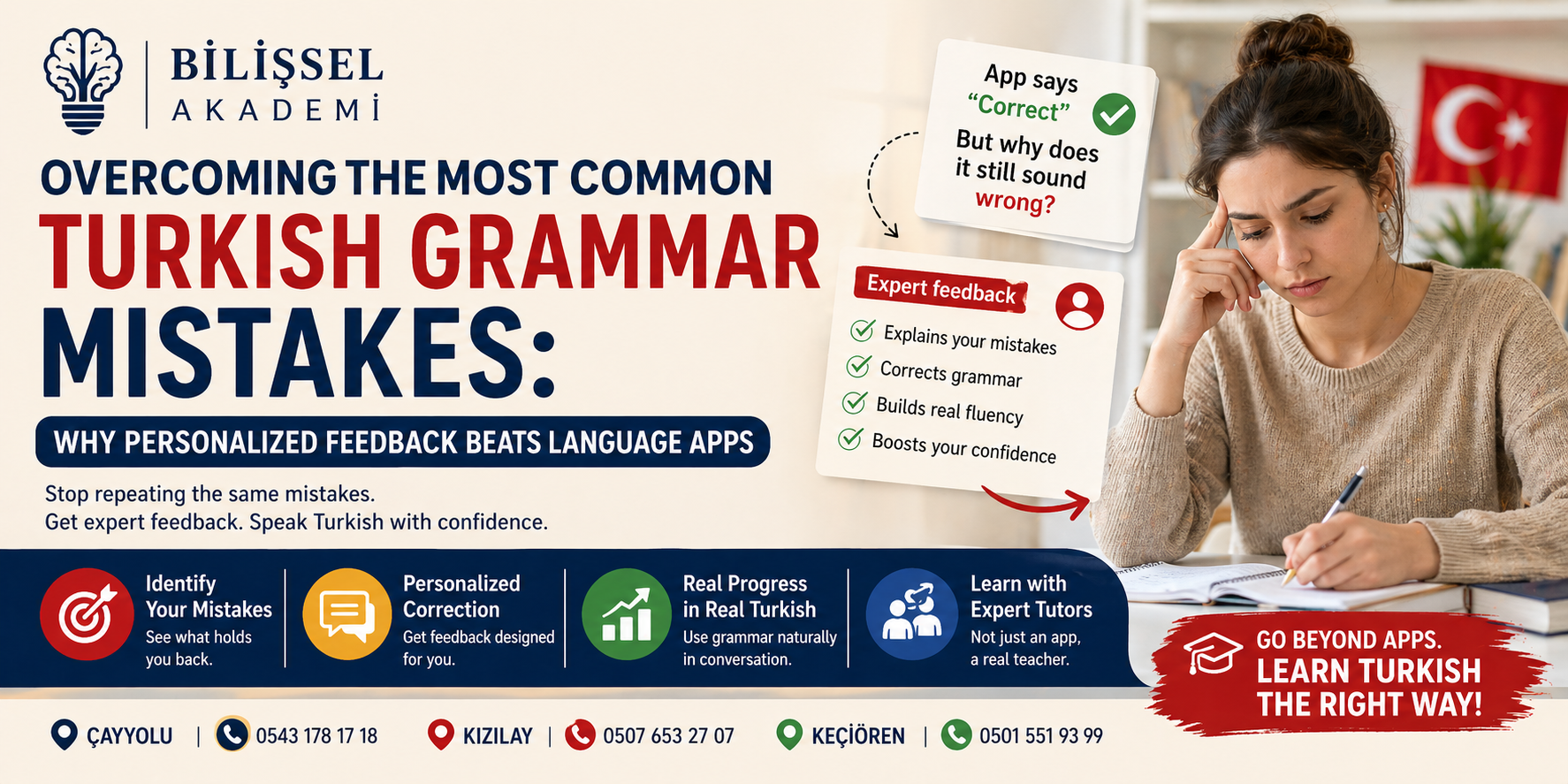
🛑 Overcoming the Most Common Turkish Grammar Mistakes:
Why Personalized Feedback Beats Language Apps
Many learners start their Turkish journey with language apps because they are easy, accessible, and highly motivating. Apps are fantastic for building daily practice habits, learning basic vocabulary, and memorizing simple phrases. However, after a certain point, a massive number of students hit a frustrating plateau. They recognize words, complete exercises effortlessly, and maintain a long streak—yet, they still make the exact same grammar mistakes the moment they try to speak or write in real life.
This plateau is especially common in Turkish. Because the language depends heavily on complex suffix stacking, vowel harmony, noun cases, and an inverted word order, a language app simply showing you a “red X” for a wrong answer is not enough. An app cannot explain exactly why your sentence sounds unnatural or how to rewire your personal mistake patterns.
This is where the transformative power of personalized feedback from a professional Turkish tutor at Bilişsel Akademi Kızılay becomes essential. In this guide, we break down the most common mistakes expats make and explain how to shift from passive app-tapping to active, confident fluency.
Why Are Turkish Grammar Mistakes So Common?
Turkish grammar is highly logical, but it is fundamentally different from English and Indo-European languages. The biggest challenge is not memorizing a rule; the real challenge is deploying that rule correctly in real-time conversations, emails, and daily situations without pausing to calculate the math in your head.
The Translation Trap
Learners try to translate directly from their native language word-by-word, creating sentences that might be technically understandable but sound completely unnatural to native ears.
Suffix Confusion
Because Turkish uses so many endings to convey prepositions, possession, and tense simultaneously, confusing just one vowel can change the entire meaning of the sentence.
Fossilized Errors
Without detailed, real-time correction from a human teacher, learners repeat the same minor mistakes until they become deeply ingrained, hard-to-break habits.
The 5 Most Common Turkish Grammar Mistakes
Most Turkish learners make predictable mistakes. Identifying them is the first step toward correcting them before they become permanent.
1. Forgetting Vowel Harmony
Vowel harmony dictates how suffixes change. Learners often know the rule in theory but forget it when speaking quickly.
- Wrong: evda / okulde
- Correct: evde / okulda
2. Using English Word Order
English follows Subject-Verb-Object, while Turkish uses Subject-Object-Verb. Forcing English logic ruins the flow.
- English logic: I am learning Turkish.
- Turkish logic: Ben Türkçe öğreniyorum. (I Turkish learning.)
3. Confusing Noun Cases
Turkish uses case suffixes (-e, -de, -den, -i) to replace prepositions. Mixing them up causes major misunderstandings.
- eve: to home
- evde: at home
- evden: from home
4. Plural Suffixes After Numbers
In Turkish, nouns remain singular when preceded by a number. This is a very common trap for expats.
- Wrong: üç kitaplar / beş öğrenciler
- Correct: üç kitap / beş öğrenci
5. Using “Sen” Instead of “Siz”
Turkish has formal (Siz) and informal (Sen) ways to say “you.” Using sen with elders or in corporate settings sounds highly unprofessional.
Why Language Apps Fail Where Tutors Succeed
Apps are great for passive exposure, but they cannot replace the nuanced, real-time feedback required to achieve conversational fluency.
From Passive Tapping to Active Speaking: Who Needs This?
Grammar-focused private Turkish lessons are ideal for learners who already know some Turkish but feel paralyzed when it is time to open their mouths. This approach is transformative for:
- Learners who completed beginner app courses but still cannot string a confident sentence together.
- Expats living in Turkey who need practical, error-free Turkish for daily life and bureaucracy.
- Professionals working in Ankara who need to stop making the same basic mistakes in front of Turkish colleagues or clients.
- Students preparing for official Turkish language exams (TYS, TÖMER) who need structured correction and guided practice.
Stop Guessing and Start Improving with Bilişsel Akademi Kızılay
Language apps are a great starting point, but they cannot fully replace the sharp, empathetic, and strategic feedback of an expert. If you keep making the same mistakes, the problem is not your intelligence or motivation—the problem is that you are not receiving the right correction at the right time.
At Bilişsel Akademi Kızılay, our VIP private tutors identify your personal error patterns, break them down in simple terms, and use role-play to rebuild your confidence. Instead of guessing whether your sentence is right, you will learn exactly how Turkish grammar functions in real communication.
Ready to Speak Confidently? Contact Us:
📍 Kızılay Branch
Ziyabey Cad. No: 15/4 (Next to Metro) Çankaya / ANKARA
Delete the doubt. Turn your passive knowledge into active, flawless Turkish today!